The influence of digital videos on our everyday culture is undeniable. Online video sharing sites such as YouTube, Vimeo and Metacafe boast monthly audience numbers in the millions.
With digital videos continuing to gain popularity, it seems only natural that this familiar and widespread platform extends into the education setting.
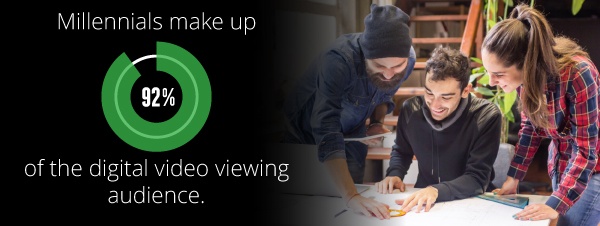
Students today are utilizing educational videos as a tool for learning everything from changing a tire to the latest dance craze. Remarkably, millennials make up 92% of the digital video viewing audience. Abstract topics that once seemed difficult to teach and learn are now more accessible and understandable thanks to the availability of educational videos.
Studies have shown that the use of short video clips allows for more efficient processing and memory recall. The visual and auditory nature of videos appeals to a wide audience and allows each user to process information in a way that’s natural to them.
The use of videos in teaching and learning serves to not only benefit students, but also teachers and their affiliated institutions. A 2015 study conducted by software company Kaltura concluded that 93% of teachers believe that the use of educational videos improves the learning experience. They also serve to break down barriers, such as student and campus location, which were once insurmountable.
As a result, educational institutions are faced with the task of meeting the rising demand for quality learning videos, online course offerings and campus accessibility. Indeed, many are choosing to create their own educational videos. While this idea may seem daunting, it can be a positive and enjoyable experience if you contract a full-service video production company that can tailor your videos to your institution’s individual needs.
Using Videos in Education
The online nature of videos allows them to be shared all across the world and at all hours of the day or night. Educational institutions can gain great autonomy by using videos to reach their broad audience. They can be used to keep potential, current and former students involved and engaged.
Videos can be used in a variety of ways in the educational setting, including:
Introducing Your Institution to Potential Students
Short video clips containing interactive maps, prominent campus personalities and important traditions and landmarks can be a great way to introduce students and their families to your facility. This is a great solution for students who are unable to visit in person. An informative campus tour video can mean the difference between a student choosing to apply to your school and nixing it from the list because of a transportation barrier.
Facilitating the Admissions and Acceptance Process
Once accepted, videos can be used to assist incoming students with completing the admissions process. These can include information for enrolling in courses, applying for housing and even investigating extracurricular activities. Descriptions of academic and other campus areas can help incoming students feel excited and accepted while at the same time offering valuable information.
Introducing Potential Students to Your Institution’s Town
Potential students and their families may not be able to physically visit the areas surrounding the campus. Creating short videos showcasing the landmarks, history and culture of their prospective new town can help them feel more at home and get acclimated quicker.
Teaching Course Material
Teachers can use videos to deliver course information that can be extremely helpful in opening up class time. Lectures and other introductory information can be viewed before class, which allows for more practice- and skill-related class activities. These videos are accessible at the student’s convenience and can be watched numerous times to assist with coursework and skill mastery.
Keeping Alumni Updated
Videos can be a great way to keep former students involved and engaged in what’s going on at their alma mater. Alumni can watch athletic events, see campus activities and accomplishments and even take online courses. This can be a powerful recruitment tool, too! Alumni who feel engaged and informed about the current status of their alma mater will be much more likely to recommend it to potential students than those who don’t.
Benefits of Using Videos in the Classroom
The benefits of using videos in an educational setting are numerous. Their convenience and versatility make them an asset to students, teachers and educational institutions alike.
Benefits to students:
- Videos create a more engaging sensory experience than using print materials alone. Learners actually get to see and hear the concept being taught and can process it in the same way they process their everyday interactions.
- They provide a go-to resource that can be watched from anywhere with an internet connection, and are accessible on a multitude of devices including laptops, tablets and smartphones. This allows for viewing at the student’s convenience and from wherever they are.
- Videos increase knowledge retention, since they can be stopped and replayed as many times as needed. They can also be reviewed long after the initial lesson was taught.
- They greatly assist in the learning of all subjects, but particularly those topics that are complex and/or highly visual (such as step-by-step procedures or science and math formulas).
- They increase proficiency in digital literacy and communication, which are important 21st century skills.
Benefits to teachers:
- Videos increase student engagement, which in turn helps boost achievement. If students are interested in the material, they will better process and remember it.
- They offer the flexibility to pause or skip throughout the video to have class discussions or review particular areas.
- They enable teachers to create a flipped classroom or “blended” learning environment. However, videos are also beneficial to teachers who teach in traditional classroom settings.
- Digital videos facilitate remote learning opportunities where teachers can reach students from all over the world.
- Many videos now contain analytic features that enable teachers to track student engagement and attendance while viewing. Companies like NextThought even provide platforms that can track how long a video was viewed for and what percentage of the video was watched. This allows the facilitator to gauge the effectiveness of the video.
- They provide opportunities for student feedback and assistance through video. This is helpful for students who are unable to attend classes, or who need tutoring or review sessions.
- Videos seek to change the roles of teachers from lecturers to facilitators. It’s important to note that videos are meant to enhance course materials and lectures — not replace them.
Benefits to institutions:
- The potential to improve marketing and communications. Digital videos help to broaden your audience by reaching a greater number of people. These can be posted on your institution’s website or linked in an email or digital advertisement, or posted on social media.
- More flexible faculty and staff training. It’s often difficult for schools to assemble their faculty and staff at the same time, resulting in fragmented information acquisition. Using digital videos as a delivery method for training ensures that your faculty and staff have equal access to the information. Offering this option not only improves their retention and recall but also serves as an archive to review it any time.
- Ability to record campus events for live or on-demand viewing. When parents, students, and alumni feel closer to what’s going on at your school, they’ll feel more invested, thus increasing the likelihood of positive recommendations and engagement with students new and old.
- Ability to increase online course offerings. Online university programs are extremely popular, due to diverse student populations. Broadening your institution’s online program can serve to greatly enhance your appeal with potential online students.
- Digital videos can be integrated into your institution’s learning management system (LMS). Enabling video clips to be easily uploaded to your LMS provides an additional resource for students and teachers.
- Increasing campus accessibility through videos conveys an attitude of positive public relations to parents, potential students, and alumni. This can attract potential students and is a powerful recruiting tool.
- The use of videos in education shows a high return on investment (ROI) in those institutions that employ a tool to measure it. This includes higher grades reported when video review modules are offered and viewed before exams.

Bahut sahi keh rhe
ReplyDeleteक्या बात है भाई। बहुत बढ़िया।
ReplyDeleteNice
ReplyDeleteAll videos are important in life. They teach us so much.
ReplyDeleteBehad umda post
ReplyDeleteWow! Very nice indeed. It was quite detailed. Keep up the good work.
ReplyDeleteInteresting.
ReplyDeleteWell said
ReplyDeleteI like your blogs, keep publishing!
ReplyDeleteComment Number 5
ReplyDeleteBajarang bali
ReplyDeleteNice blog, keep it up 👍🏾
ReplyDeleteInsightful
ReplyDeleteWell Written Vikash ji!!
ReplyDeleteAmazing work.
ReplyDelete